What you'll get from this lesson: Set up a game from scratch — shuffle, build the wall, roll, break, and deal the right number of tiles.
With the tiles in hand, let’s set up a game. It’s a little ritual, and it’s part of the fun.
Wash, then build
Turn every tile face-down in the middle of the table and swirl them around to mix them — players call this washing the tiles. Then each player stacks tiles into a low wall, two high and nineteen long. The four walls slide together into a square that holds every tile in the set.
Building the Wall & Starting the Deal
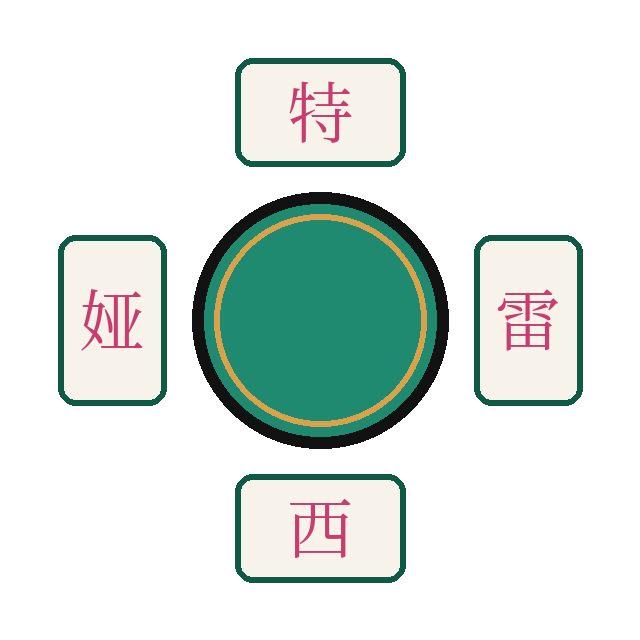
Original schematic. Wash the tiles face-down, each player builds a wall 19 long and 2 high, the four walls form a square. East rolls the dice to pick the break point, then deals — East ends with 14 tiles, everyone else 13.
Roll, break, and deal
Each player rolls the dice, and the player who rolls the highest number is East.
East will then roll the dice to see where they will break (or cut) their wall. If they roll a 5, they will count from right to left 5 tiles over and break the wall between the 5th and 6th tiles. This means the first 5 stacks of tiles will stay against East’s rack. The rest of the 14 stacks of tiles will be pushed out into the middle of the table. East will take the first 2 stacks of 2 tiles (total of 4 tiles) and, playing to East’s right (counterclockwise), each player will pick up 4 tiles until everyone has 12 tiles. East will then take the top tile of the 1st and 3rd tiles so they will have a total of 14 tiles in front of them. The next player will take 1 tile, as will the next 2 players, and they will each have 13 tiles.
Once everyone has the correct number of tiles, each player will place those tiles on their rack.
Sort and look
Set your tiles on your rack, facing you, and arrange them in an order that makes sense — many players group by suit and number. Then glance at your card and notice what you’ve got. Don’t worry if nothing forms a clear hand yet; almost no one starts with a good hand. That’s exactly what the next step — the Charleston — is designed to fix.